Shipboard Engineering Journal

Design the ship around the science

A working research vessel succeeds or fails on deck geometry, acoustic discipline, and the short walk between winch rail and laboratory bench.

Follow the research workflow

Begin with the mission list

Four operational demands that govern every hull, winch, and bulkhead decision.

  • Mission Profile Hydrography, coring, polar transit

    Before a naval architect draws frames, science committees define payload weights, sea-state cutoffs, ice class, and endurance days on station.

    Read Missions
  • Over-the-Side Handling A-frames, CTD hangars, winch leads

    Heave compensation, fairlead angles, and sheltered side bays govern whether delicate sensors survive launch and recovery in Force 6 swells.

    Inspect Equipment
  • Shipboard Laboratories Wet labs, clean benches, van bays

    Deck tie-downs on a 610 mm grid, trace-metal clean air locks, and continuous seawater lines keep samples uncontaminated at sea.

    Tour Laboratories
  • Acoustic Quietness ICES 209, DNV Silent-R, diesel-electric

    Rafted generators, skewed propellers, and bubble-swept hull gondolas prevent machinery vibration from blinding multibeam echosounders.

    Explore Quiet Operation

On deck with the science team

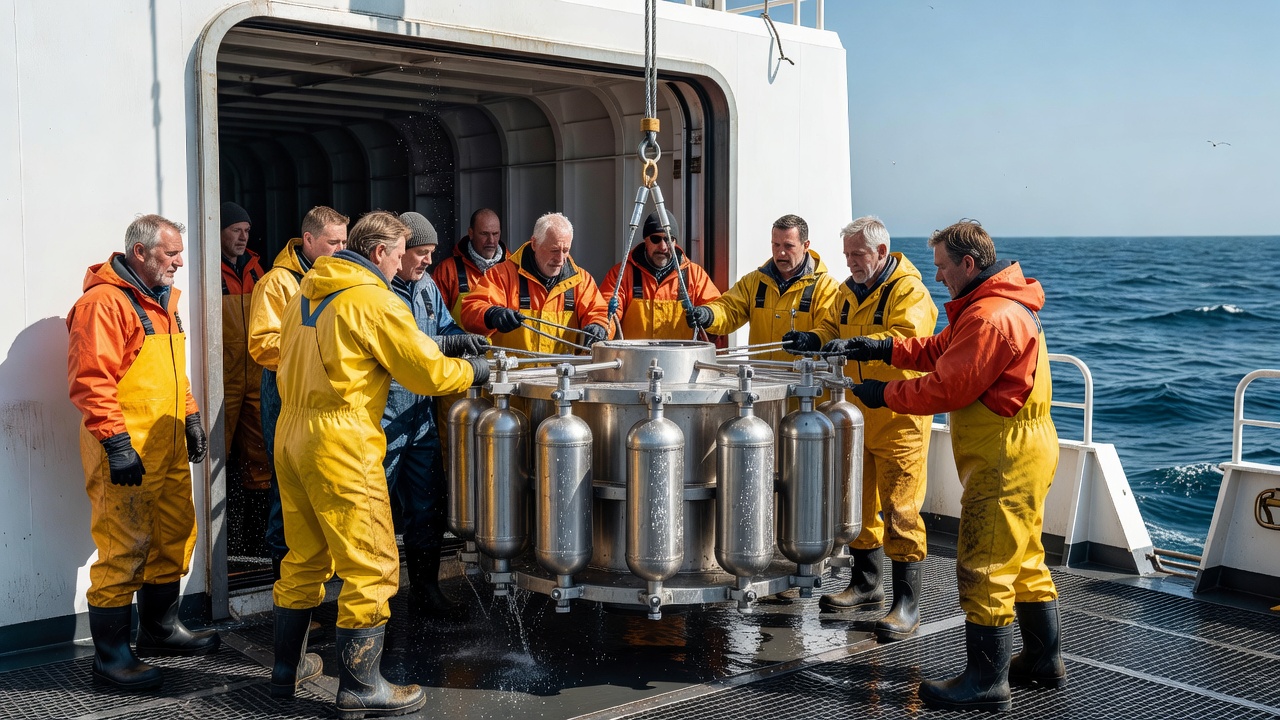
Deck planning revolves around clear sightlines from winch cab to water entry.

Deck technicians in foul-weather gear guiding a stainless steel CTD water-sampling rosette through a side hangar door in daylight
CTD rosette recovery via sheltered starboard hangar reduces pendulum swing. Station work, sea state 4

A research ship's aft working deck behaves like an outdoor machine shop. Every bolt-down socket, hydraulic manifold, and scupper drain is arranged so a morning plankton tow can clear away before an afternoon piston corer rig moves into the stern A-frame.

Stern A-Frame
20–35 tonne safe working load, outreach 4.5 m past transom for box corers and ROVs.
CTD Winch & Wire
0.322-inch electro-optical cable up to 10,000 m with active heave compensation.
Tie-Down Matrix
Flush 25 mm UNC threaded deck sockets on 610 mm centers rated to 45 kN pull.
Containerised Vans
ISO 20-foot twistlocks with dedicated 440 V power, freshwater, and Ethernet trunks.
A steady platform for measurement

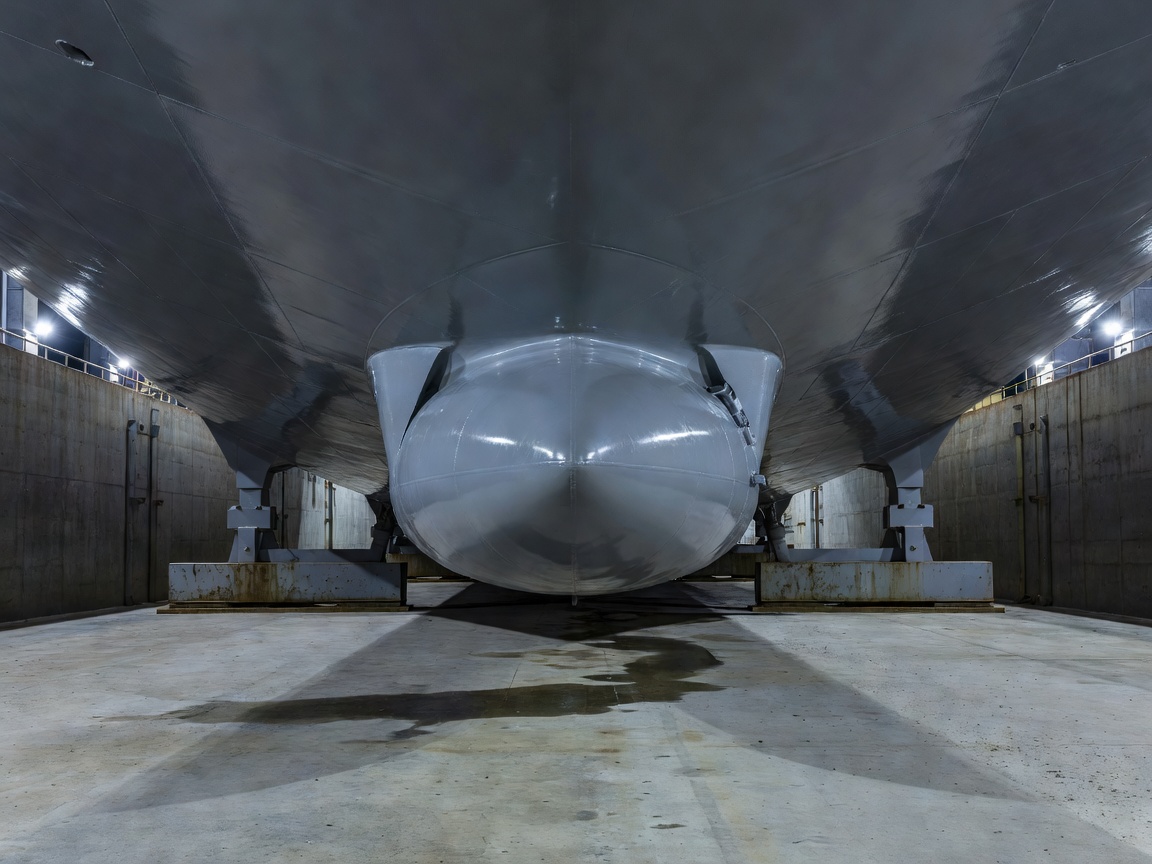
Underwater acoustics demand hull forms that shed air bubbles away from sensor arrays.

Even the sharpest multibeam sonar fails if hull pitching sweeps aeration across the transducer face. Modern vessels such as R/V Neil Armstrong and RRS Sir David Attenborough pair deep bulbous bows with streamlined hull gondolas or drop keels that lower acoustic arrays below the boundary layer.

Propulsion plants follow the same logic: variable-speed diesel-electric drives mounted on double-resilient rafts isolate engine harmonics so surveys meet the ICES Cooperative Research Report No. 209 underwater noise curve up to 11 knots.

Read power, noise and endurance
Drydock inspection view of a research ship hull underside showing recessed acoustic transducer gondola and smooth anti-fouling finish
Flush gondola fairing protects Kongsberg multibeam arrays from bubble sweepdown. Hull acoustic zone

From sample to laboratory

Minimising carry distance preserves temperature, dissolved gases, and trace-metal integrity.

01 / Recovery

Starboard Hangar

Niskin bottles and biological nets arrive inside a heated, waist-high staging bay shielded from salt spray and exhaust fumes.

02 / Sub-sampling

Wet Laboratory

Gimballed benches, floor troughs, and uncontaminated seawater taps let teams draw oxygen, salinity, and nutrient vials within minutes.

03 / Analysis

Dry & Clean Labs

Positive-pressure HEPA clean rooms and anti-vibration microscope plinths allow shipboard spectroscopy and core logging underway.

04 / Archiving

Cold Stores & Data

-80 °C ultra-low freezers and mirrored shipboard servers lock away sediment cores and bathymetry before port call.

Read the vessel record

Documented ships illustrating how mission requirements translate into displacement, range, and quietness.

Vessel Operator Length / Displacement Ice & Endurance Primary Design Focus
RRS Sir David Attenborough British Antarctic Survey 129 m / 15,000 t Polar Class 5, 60 days Moonpool, 720 m2 lab space, DNV Silent-R
R/V Neil Armstrong Woods Hole Oceanographic Inst. 72.5 m / 3,043 t Open ocean, 40 days Single-hull AGOR, acoustic gondola, 11-kt quiet survey
R/V Sikuliaq University of Alaska Fairbanks 79.6 m / 3,665 t PC5 ice-capable, 45 days Centerboard drop keel, heated aft working deck
R/V Kronprins Haakon Norwegian Polar Institute / IMR 100 m / 9,000 t PC3 icebreaker, 65 days Dual moonpools, helicopter hangar, pelagic trawling
R/V Aranda Finnish Environment Institute (SYKE) 66.3 m / 1,925 t Finnish-Swedish 1A, 30 days Baltic brackish-water chemistry, winter ice operations

Before the next expedition

View all 9 expedition FAQs

Why do research ships use diesel-electric propulsion instead of direct shaft diesels?

Diesel-electric plants run only as many generators as current load requires, keep constant prime-mover speed for low emissions, and isolate engine vibration through electric motors and resilient rafts during slow acoustic transects.

What is a scientific moonpool and when is it worth the hull drag?

A vertical shaft cut through the ship's hull lets teams deploy ROVs, core drills, or CTD frames through calm, ice-free water near midships, though doors or baffles are needed to prevent resonance during transit.

How many science containers can an ocean-class ship support?

Regional and global vessels typically reserve deck footprints for two to six 20-foot ISO science vans, each wired with 440 V three-phase power, seawater supply, drainage, and fibre-optic network links.