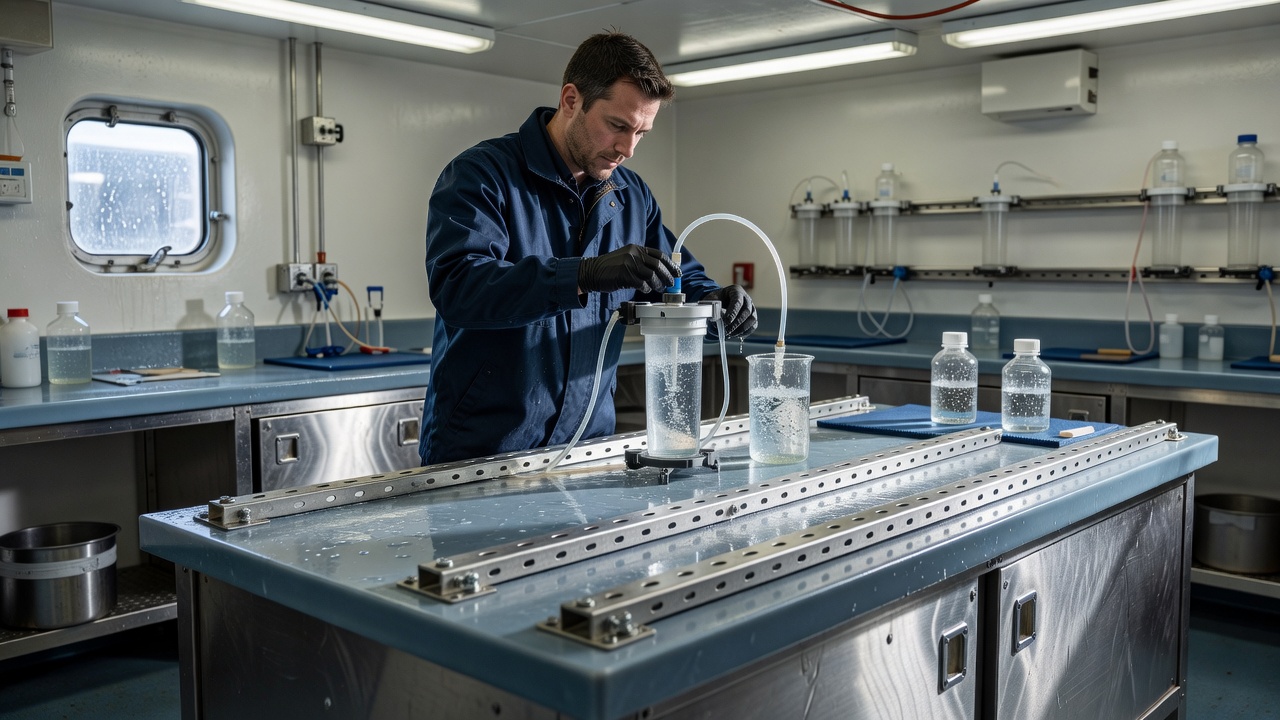
Layout logic from transom door to analytical bench
The layout of scientific spaces follows a strict contamination and moisture gradient. Wet laboratories open directly onto the aft working deck or CTD hangar through wide, watertight double doors with low coamings so heavy core barrels and water crates wheel straight inside on deck trolleys. Floors use welded, non-slip vinyl or epoxy surfaces sloped toward deep perimeter gutters fitted with sediment traps.
Further forward toward midships—where pitch and heave accelerations are lowest—sits the main dry laboratory. Bulkheads and overheads are lined with stainless-steel Unistrut mounting channels every 600 millimetres, allowing research teams from Scripps Institution of Oceanography (SIO), Woods Hole Oceanographic Institution (WHOI), or the Alfred Wegener Institute (AWI) to bolt down mass spectrometers, flow cytometers, and laser diffraction counters in hours without drilling the ship's fire boundaries.
Trace-metal clean rooms and non-metallic plumbing
Measuring dissolved iron, zinc, or lead at picomolar ocean concentrations aboard a 3,000-tonne steel ship is a constant battle against rust and stack exhaust. Dedicated clean chemistry suites replace bare steel fasteners with titanium, PTFE, and epoxy-coated joinery, maintaining positive air pressure fed through ISO Class 5 HEPA filtration so ambient ship dust stays outside the airlock.
Uncontaminated underway seawater systems follow equally strict material rules. A dedicated intake near the bow—well forward of sewage, greywater, and engine-cooling discharges—pumps surface ocean water through inert PVC, PVDF, or polyethylene piping straight to laboratory sinks and fluorometers. No copper, brass, or sacrificial zinc anodes are permitted in the scientific seawater loop, because metal ions leached from fittings would poison phytoplankton productivity incubations.
Vibration isolation, clean power, and fume extraction
Sensitive optical balances and compound microscopes cannot resolve cells if hull plating hums at 25 hertz from propeller blade-pass frequencies. Laboratories solve this with elastomeric bench mounts, active pneumatic isolation tables, and dedicated uninterruptible power supplies (UPS). Scientific power circuits are galvanically isolated from heavy winch inverters and galley motors, preventing voltage spikes from corrupting multi-day chromatography runs.
Fume hoods and radioisotope benches receive separate exhaust trunks rising high up the mainmast, routed away from fresh-air intakes and the aft working deck where crew handle lines. On polar ships operating in sub-zero air, heat-recovery coils temper makeup air before it sweeps across acid-digestion hoods so laboratory temperatures stay steady within one degree Celsius.
Modular ISO laboratory vans and cold storage
Even a large global vessel cannot hold permanent laboratories for every sub-discipline simultaneously. That is why aft and upper-deck footprints accommodate ISO 20-foot containerised labs—specialised radiation vans, hyperbaric fish tanks, or trace-metal clean vans pre-built ashore at a university workshop and craned aboard before sailing. Once locked into deck twistlocks, umbilical manifolds connect potable water, compressed air, chillers, and gigabit fibre directly into the ship's central data acquisition backbone.
Completing the sample chain are temperature-controlled environmental rooms and ultra-low freezers (-20 °C and -80 °C) connected to emergency generator buses. Sediment core liners split and logged on deck move straight into 4 °C refrigerated holds, guaranteeing intact stratigraphy until shore-based core repositories take over.