Why underwater noise ruins oceanographic data
For commercial vessels, engine noise is merely a crew comfort question. On a scientific vessel carrying Kongsberg EM 304 deep-water multibeam echosounders, sub-bottom profilers, and acoustic Doppler current profilers (ADCPs), self-noise directly shrinks maximum depth reach and corrupts backscatter measurements. Worse, fish such as Atlantic herring and Arctic cod detect approaching noisy hulls hundreds of metres ahead and dive out of acoustic survey beams, biasing stock assessments at institutions like Norway's Institute of Marine Research (IMR).
In 1995, the International Council for the Exploration of the Sea published ICES Cooperative Research Report No. 209, establishing a benchmark underwater radiated noise curve at 11 knots. Classification societies later formalised those targets into notations such as DNV Silent-R and Bureau Veritas URN-Research, verified on deep-water acoustic ranges using calibrated hydrophone arrays under ISO 17208 procedures.
Diesel-electric plants and double-resilient rafts
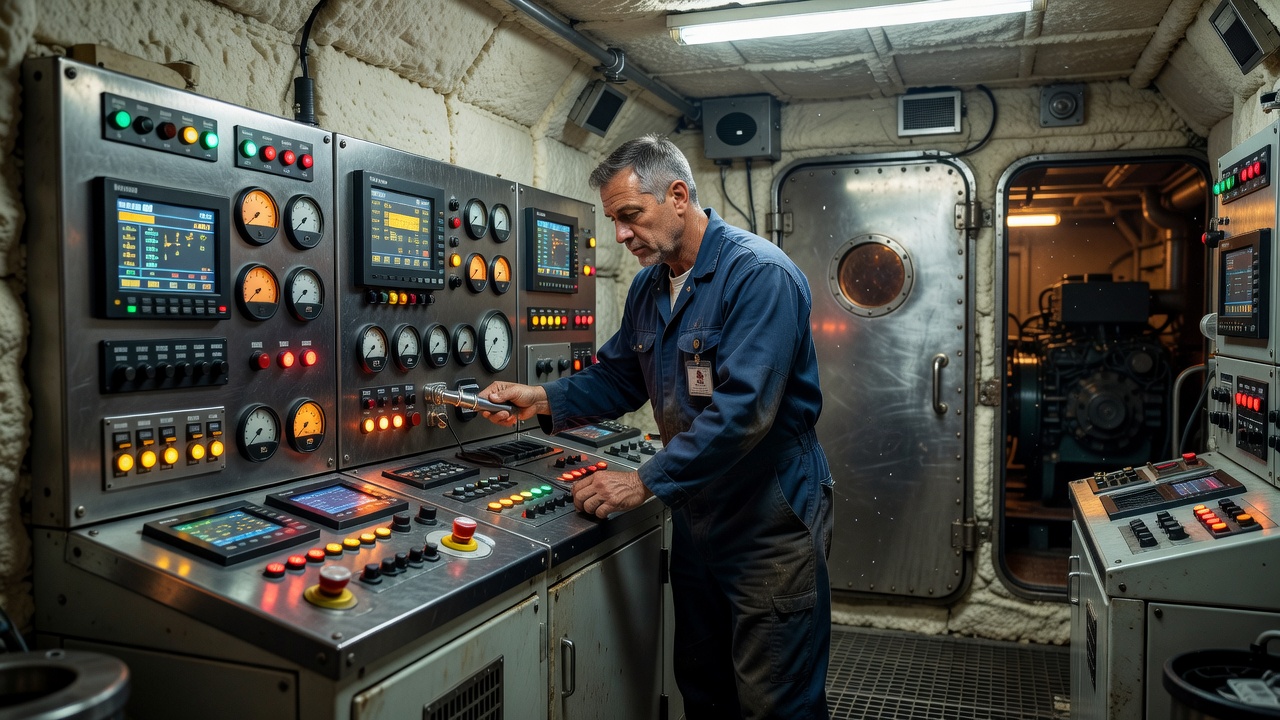
Achieving ICES 209 compliance starts by severing mechanical paths between diesel cylinders and the hull plating. Instead of bolting two giant slow-speed engines straight onto tank tops, modern ships install three to five medium-speed diesel generators on heavy steel sub-frames supported by double-stage rubber or pneumatic mounts. Flexible bellows isolate exhaust risers, fuel hoses, and cooling pipes so structure-borne vibration cannot bypass the raft.
Electric power then feeds permanent-magnet or AC synchronous propulsion motors turning fixed-pitch propellers at variable revolutions per minute. Fixed-pitch blades have a dramatic acoustic advantage over controllable-pitch propellers (CPPs): a CPP running at constant shaft RPM but low blade angle sheds fierce tip-vortex cavitation across the water, whereas a variable-speed fixed-pitch wheel slows down smoothly so blade tips stay well below cavitation inception speed up to 11 or 12 knots.
Bubble sweepdown and propeller geometry
Air bubbles trapped beneath the bow are just as destructive as engine rattle. As a vessel pitches into head seas, air entrained near the forefoot sweeps aft along the keel and blankets hull-mounted transducers in a white curtain that blocks acoustic pings. Naval architects counter this with deep, steeply raked bow stems, rounded bilges, and flush hull gondolas or extendable drop keels that push sensors 1.5 to 3 metres below the ship's turbulent boundary layer.
Propeller designers simultaneously craft five- to seven-bladed high-skew wheels tested inside cavitation tunnels prior to sea trials. High blade skew spreads pressure pulses gradually across the stern aperture, while wake-equalising fins smooth inflow behind the skeg—cutting low-frequency tonal spikes that would otherwise blind fishery echosounders.
Battery hybrids, shore power, and emission tiers
A new generation of coastal and regional ships, including upgrades across Nordic fleets overseen alongside agencies such as the Finnish Environment Institute (SYKE) and the Finnish Meteorological Institute (FMI), adds lithium-ion battery banks to DC-grid power plants. During delicate plankton transects or short coastal stations, batteries let the ship shut down every diesel generator for hours of zero-combustion, zero-exhaust acoustic silence.
When diesels do run, selective catalytic reduction (SCR) exhaust scrubbers meet MARPOL Annex VI Tier III nitrogen oxide limits, while battery peak-shaving absorbs sudden winch spikes during heavy CTD hauls so remaining generators hold steady, fuel-efficient loads. Across 40- to 60-day ocean expeditions, that disciplined power management stretches endurance while keeping atmospheric chemistry sensors upwind of the funnel completely clean.