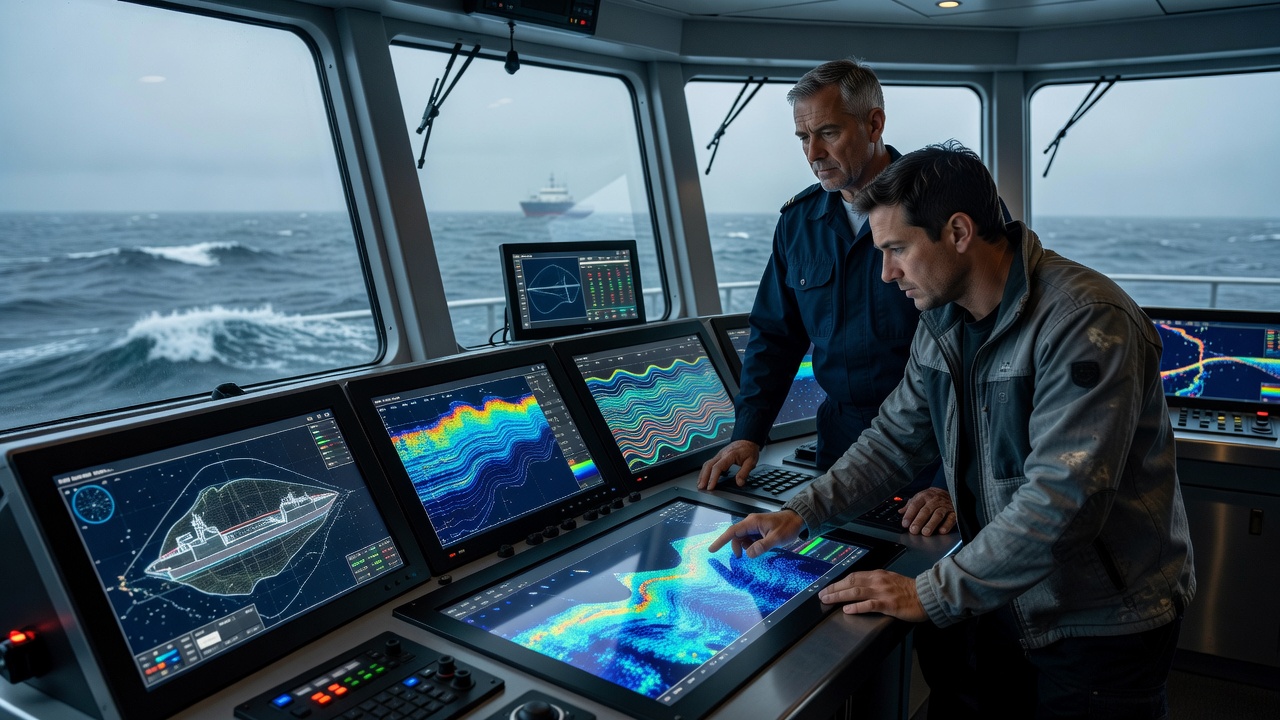
From science committee wish list to hull lines
Unlike cargo ships sized for container slots or deadweight tonnes, an oceanographic vessel is sized around working deck area, wet and dry laboratory square metres, and the number of scientific berths needed to staff 24-hour watch rotations. In the United States, the University-National Oceanographic Laboratory System (UNOLS) frames this early stage through formal Science Mission Requirements (SMR), while European consortia such as the German Federal Ministry of Education and Research (BMBF) and the British Antarctic Survey run multi-discipline workshops years before cutting steel.
Early trade-offs are concrete and unforgiving. Adding twelve extra science berths forces larger freshwater evaporators, bigger galley cold stores, additional lifeboat capacity under SOLAS rules, and a wider beam to retain intact stability. Extending range from 30 days to 60 days—essential for Southern Ocean crossings aboard ships like RRS Sir David Attenborough—increases fuel bunker volume substantially, shifting the vertical centre of gravity as tanks empty late in a voyage.
Seakeeping, station-keeping, and deck elevation
Researchers rarely work in glassy calms. Mission profiles usually require continuous CTD casts and ROV launches up through Sea State 5 (2.5 to 4.0 metre significant wave height) and safe survival above Sea State 8. Naval architects tune metacentric height and bilge keel geometry so roll periods stay long and gentle rather than snappy; rapid accelerations ruin microscope work and overload crane wires.
Equally decisive is freeboard at the stern. If the aft working deck sits too high above the waterline, recovery crews lose visual contact with instruments in trough waves and pendulum arcs lengthen dangerously beneath the A-frame. If the deck sits too low, green water sweeps across sample boxes when backing into swell during station-keeping. Most modern global-class vessels—including R/V Sonne and RRS Discovery—set aft freeboard between 2.2 and 3.0 metres, paired with freeing ports and removable bulwark gates.
Ice-class hulls and polar operational limits
Vessels scheduled for the Arctic, Fram Strait, or Baltic winter sea ice must satisfy the IMO Polar Code and structural rules such as Polar Class 5 (PC5) or the Finnish-Swedish Ice Class 1A carried by Helsinki's R/V Aranda. Ice-strengthened bows use thicker shell plating, closely spaced intermediate frames, and rounded stem angles designed to ride up onto level ice and break it by weight rather than blunt impact.
Polar missions also force changes that are invisible in mild latitudes. Sea chests must include heated recirculation loops so brash ice never starves cooling-water intakes. Aft deck plates and walkways receive glycol heating pipes or enclosed hangars so hydrowire sheaves do not freeze solid between casts, while lifeboats and davits require winterised enclosures rated down to minus 30 degrees Celsius.
Moonpools, drop keels, and flexible deck grids
Two structural apertures define high-capability research hulls: the scientific moonpool and the retractable drop keel. A moonpool—found aboard R/V Kronprins Haakon and RRS Sir David Attenborough—opens a vertical trunk right through the centre of flotation, where pitch and heave accelerations are smallest. Teams can lower autonomous vehicles or sediment drills through heavy pack ice without exposing cables at the stern. Because open trunks add hull drag and sloshing during fast transits, hinged bottom doors and perforated damping baffles are standard.
To keep future-proofing intact over a 30-year service life, mission requirements also mandate modular deck grids and plug-and-play van footprints. Rather than permanently welding specialised hardware for a single decade of oceanography, shipyards install standardised threaded tie-down matrices across both main and upper decks so acoustic arrays, seismic compressors, and portable isotope vans can be swapped in a single port call.