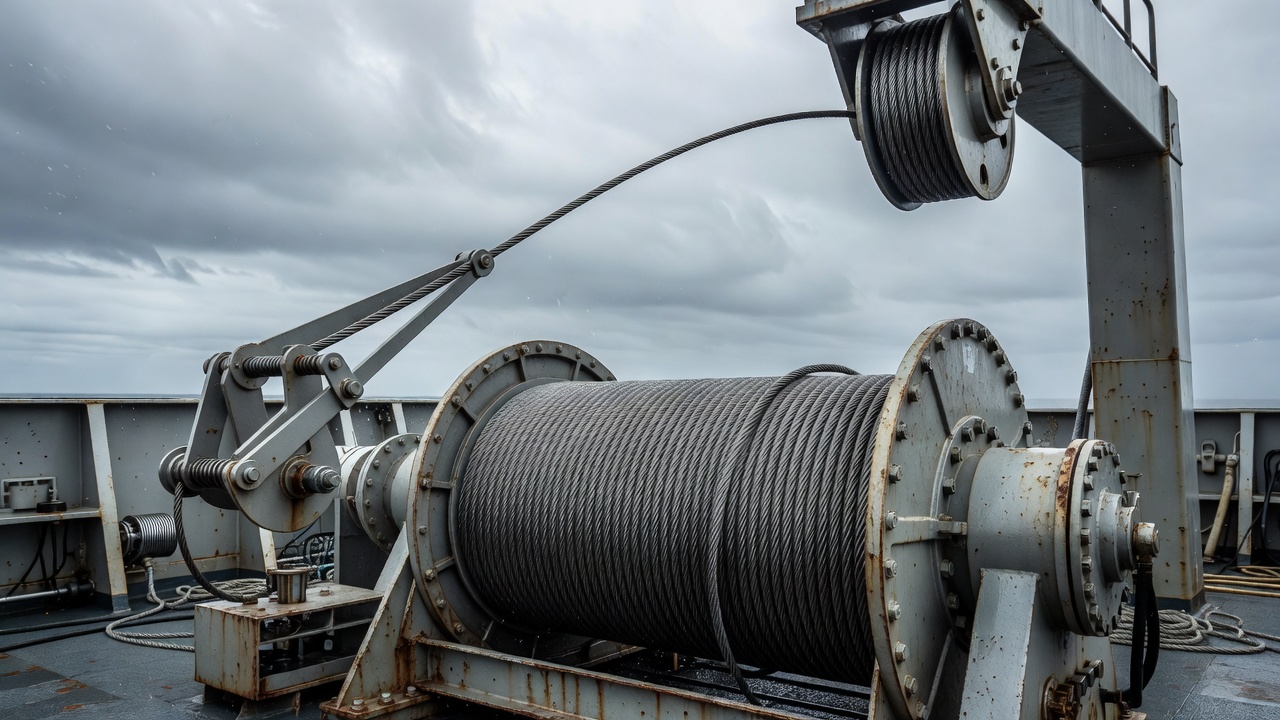
Winch architecture and traction drums
Deep-sea oceanography relies on three distinct winch classes: hydrographic winches spooled with thin three-conductor cable for Sea-Bird SBE 911plus CTD rosettes; heavy coring and trawl winches handling 14 to 28 millimetre steel wire or synthetic plasma rope; and fibre-optic umbilical winches feeding live high-definition video and telemetry to work-class remotely operated vehicles (ROVs).
On long cables exceeding 6,000 metres, spooling thousands of metres directly onto a single storage drum under full load crushes lower layers and damages delicate copper or optical cores. Modern ships such as R/V Falkor (too) and R/V Sikuliaq solve this with dual-drum traction winches. A pair of grooved capstans absorbs the high hauling tension near the fairlead and feeds the wire onto a low-tension storage drum tucked inside a climate-controlled winch room below decks.
Active heave compensation at the air-sea interface
The highest snap loads occur as an instrument passes through the surface wave zone or approaches the seabed during piston coring. When the ship's stern pitches downward and then snaps upward, uncompensated wire can go slack and suddenly shock-load beyond its safe working limit—defined under UNOLS Research Vessel Safety Standards (RVSS) with strict safety factors.
Active Heave Compensation (AHC) continuously reads vertical acceleration from the vessel's inertial motion reference unit and drives high-response electric or hydraulic winch motors to pay out as the ship rises and haul in as it falls. Holding a benthic lander steady within 15 centimetres of the abyssal plain allows delicate sediment traps and ROV docking latches to engage cleanly in swell.
A-frames, knuckle-boom cranes, and fairlead geometry
Stern A-frames remain the workhorse for towing seismic streamers, plankton nets, and giant piston corers up to 24 metres long. Hydraulic luffing rams swing the frame from inboard stowage to an outboard reach several metres clear of the transom, keeping suspended loads away from rudders and azimuthing thrusters. Side J-frames or telescoping cranes handle midships CTD casts where vertical motion is gentler than at the stern.
Every sheave along the cable path must respect minimum bend-radius rules—typically 20 to 24 times the cable diameter for steel-armoured wire and larger for fibre-optic umbilicals. Sharp fleet angles or undersized blocks induce fatigue breaks right at the termination, a failure mode that deck engineers monitor with load-cell tensiometers and regular ultrasonic wire inspections.
Sheltered CTD hangars and synthetic lines
Winter work in the Norwegian Sea or Bering Sea drove a major shift away from open side decks toward enclosed CTD hangars. Inside a heated alcove on R/V Kronprins Haakon or R/V Neil Armstrong, sliding doors open only when the rosette is ready to go overside. Technicians secure the 24-bottle frame on hydraulic trolley rails, protecting glass thermometers and Niskin bottle lanyards from freezing spray.
At the same time, ultra-high-molecular-weight polyethylene (UHMWPE) ropes are steadily replacing steel wire for trace-metal clean casts and heavy seabed moorings. Synthetic rope is nearly neutrally buoyant in seawater, removing thousands of kilograms of dead wire weight so a 60-metre coastal ship can reach abyssal depths without upsizing its winch foundations.